1
/
of
4
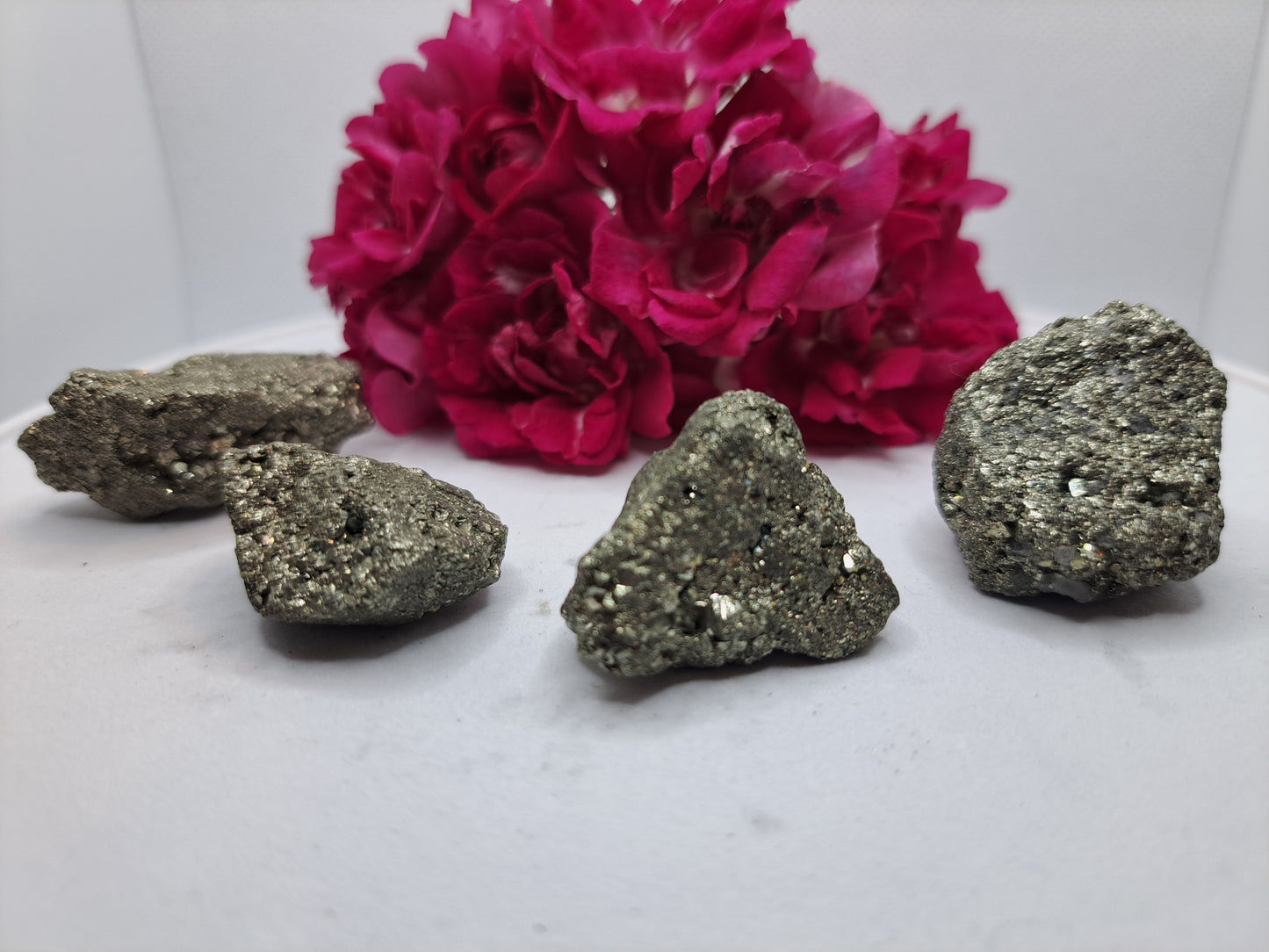
Raw pyrite crystal stone
Raw pyrite crystal stone
Regular price
£6.00 GBP
Regular price
Sale price
£6.00 GBP
Unit price
/
per
Taxes included.
Shipping calculated at checkout.
Pyrite is commonly referred to as “fool’s gold.” Although much lighter than gold, its brassy colour and relatively high density misled many novice prospectors. Its name is derived from the Greek word pyr, meaning “fire,” because it emits sparks when struck by iron. It is opaque and pale silvery yellow when fresh, turning darker and tarnishing with exposure to oxygen.
FUN FACT: Pyrite has a high melting point of around 1,070 Celsius.
- Igneous rocks: Pyrite can be found in igneous rocks, such as granite, gabbro, and basalt, particularly in hydrothermal veins and disseminated throughout the rock.
- Sedimentary rocks: Pyrite is commonly found in sedimentary rocks, such as shale, sandstone, and limestone, as nodules, concretions, or disseminated grains.
- Metamorphic rocks: Pyrite can be present in metamorphic rocks, such as schist, gneiss, and slate, formed through the metamorphism of existing sedimentary rocks or other pyrite-containing minerals.
- Hydrothermal veins: Pyrite can occur in hydrothermal veins associated with various types of ore deposits, including gold, copper, and lead-zinc deposits.
- Coal deposits: Pyrite is often associated with coal deposits, where it forms as a result of organic matter decomposition and subsequent mineralization.
- Composition: Pyrite is composed of iron (Fe) and sulfuric (S) atoms in a 1:2 ratio, with two sulfuric atoms for every one iron atom. Its chemical formula is FeS2, indicating that it consists of an iron atom bonded to two sulfuric atoms.
- Crystal structure: Pyrite crystallizes in the cubic system and belongs to the isometric crystal class. It has a distinctive cubic or octahedral crystal shape, with a brassy-yellow to pale-gold colour and a metallic luster.
- Hardness: Pyrite has a hardness of 6 to 6.5 on the Mohs scale, which means it is relatively hard and can scratch glass.
- Density: The density of pyrite is around 4.8 to 5.0 g/cm^3, which is relatively heavy compared to many other minerals.
- Magnetism: Pyrite is weakly magnetic, meaning it can be attracted to a magnet. However, its magnetic properties are typically not very strong.
- Reactivity: Pyrite is relatively inert and does not easily react with water or most acids. However, it can slowly oxidize in the presence of oxygen and water, forming sulfuric acid and iron oxide minerals, which can result in the formation of acid mine drainage in certain environments.
Product features
Product features
Materials and care
Materials and care
Merchandising tips
Merchandising tips
Share